
Medical Billing Checklist, From Booking to Bank
How to use this medical billing checklist
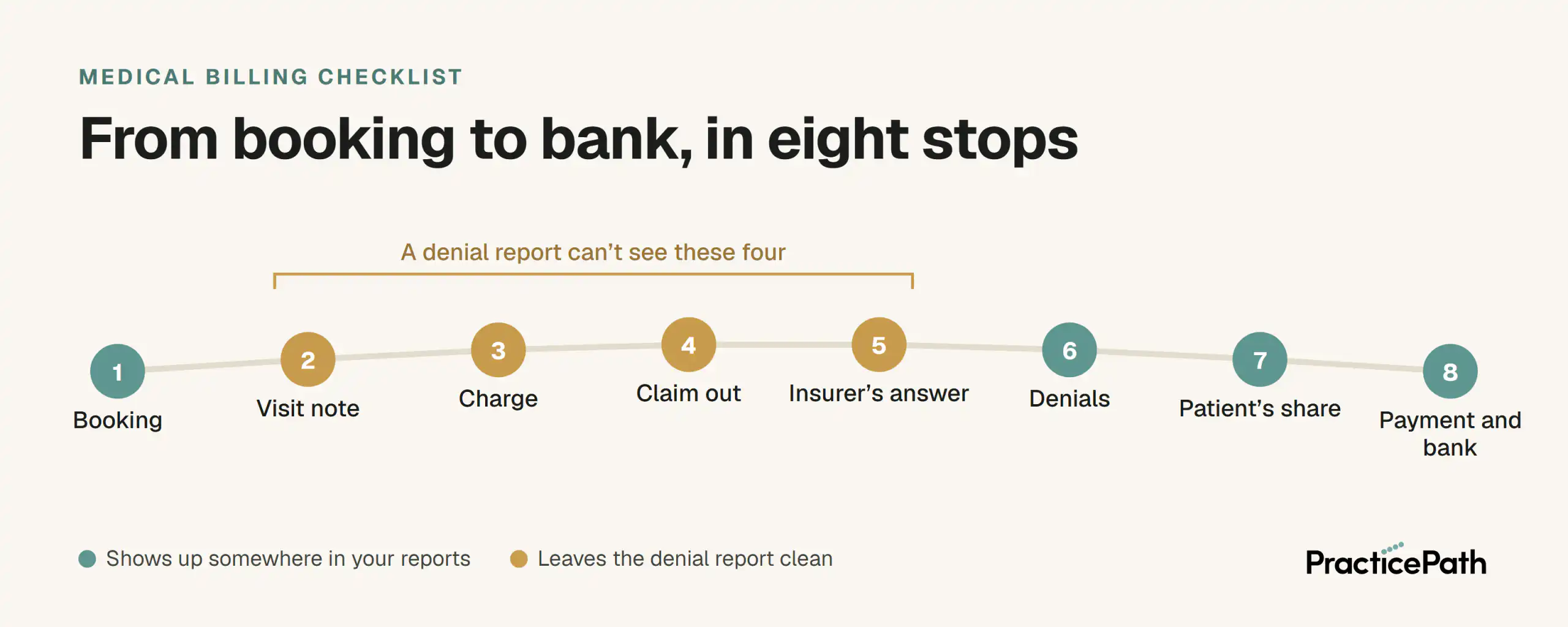
When the money looks wrong, the first instinct is to replace someone: the biller, the billing company, or the software. Before you do, walk one dollar from the booking to the bank. Each stop below shows what you’d notice, the likely cause in the setup, and one check that settles it.
Print it or pass it around. It’s free, with no email needed.
The setup is the settings, connections, and handoffs your practice runs on. Check it first, because a setup problem repeats on every claim, every bill your practice sends to an insurance company.
1. The booking
You’d notice: claims coming back for coverage that ended, or for a plan the clinician isn’t in.
Likely cause: insurance checked once, when the visit was booked, and not again before the visit.
The check: on tomorrow’s schedule, count the visits with coverage confirmed in the last two days.
2. The visit note
You’d notice: last week’s visits with no bill sent for them yet.
Likely cause: notes waiting on a clinician’s signature, with no daily list and no name on it.
The check: count the notes still unsigned the day after the visit, by clinician.
3. The charge
You’d notice: a full schedule and a thin day of charges, the visits turned into billable lines.
Likely cause: no step that matches visits seen to charges entered.
The check: compare last week’s visits marked seen with the visits that have a charge.
4. The claim going out
You’d notice: charges entered, but the claim never sent.
Likely cause: claims held by an edit that nobody is assigned to clear.
The check: list the claims built and not sent, oldest first.
5. The insurance company’s answer
You’d notice: one insurance company gone quiet.
Likely cause: the electronic connection to that insurer dropped or was never finished. It isn’t ignoring you. It has no record you billed it.
The check: for each insurer, count the days since its last payment and compare that with its normal gap.
6. Denials
You’d notice: the same denial, an insurer’s refusal to pay with a reason code, piling up in one place.
Likely cause: one wrong setting on a clinician’s record or on a billing rule.
The check: sort the last 90 days of denials by clinician, insurer, and location before you work a single one.
7. The patient’s share
You’d notice: patient balances growing month over month.
Likely cause: no estimate before the visit, and nothing collected at it.
The check: compare what patients paid at the visit with what got billed to them afterward.
8. The payment and the bank
You’d notice: a good month on paper and a thin bank account.
Likely cause: payments that reached the bank and were never recorded. Or a takeback, meaning money an insurer took back after paying, that nobody reopened.
The check: match one week of deposits to the payments your billing system recorded.
The four stops a denial report can’t see
Stops 2 through 5 never produce a denial. An unsigned note, a missing charge, an unsent claim, and a silent insurer all leave the denial report clean. So the denial report can look clean while the bank account runs thin.
People come last
If every check above comes back clean, then look at workload and training. A stretched person working inside a broken setup looks like a bad hire, so fix the setup first and judge the person after.
Grab 30 minutes with us. Prep nothing. You will see which stop your money is waiting at.
© 2026 PracticePath. All rights reserved. You may print and share this page unchanged, with credit to PracticePath.